
On this page
- Which houses is copper for?
- What is different about installing it?
- How will the color change?
- Will copper stain the house?
- Half-round or K-style?
- How does the cost stack up?
- What maintenance does copper need?
- Does copper pay back at sale?
- Can copper meet aluminum?
- What about copper leaders?
- Can old copper be saved?
- Does copper suit Arlington's trees?
- Is copper a sensible choice for one bay or porch?
- Who should install it?
Which houses is copper for?
Houses where the gutter line matters to the facade: early homes in districts like Maywood and Lyon Village, stone and brick houses, and high-end renovations. It pairs naturally with slate, cedar and masonry. On a plain modern house, aluminum usually makes more sense.
What is different about installing it?
| Stage | Copper practice |
|---|---|
| Making the gutter | K-style can be rolled on site; half-round normally arrives in lengths |
| Joining | Soldered laps and miters |
| Fixings | Copper or brass brackets and fasteners only |
| Leaders | Round with half-round; rectangular with K-style |
| Movement | Expansion allowance on long lengths |
Soldering takes skill and time, which is much of the cost. The Copper Development Association publishes guidance on weights, laps and expansion.
How will the color change?
| Age | Appearance |
|---|---|
| New | Shiny copper |
| A few months | Warm brown |
| A year or two | Deeper brown |
| Many years | Possible green patina, depending on exposure |
Most owners let it weather; a few clean it to keep it bright.
Will copper stain the house?
It can. Water running off copper carries salts that mark light stone, concrete and pale brick blue-green. Bring leaders down where the runoff lands on planting, gravel or a drain, and keep drips off light paving.
Half-round or K-style?
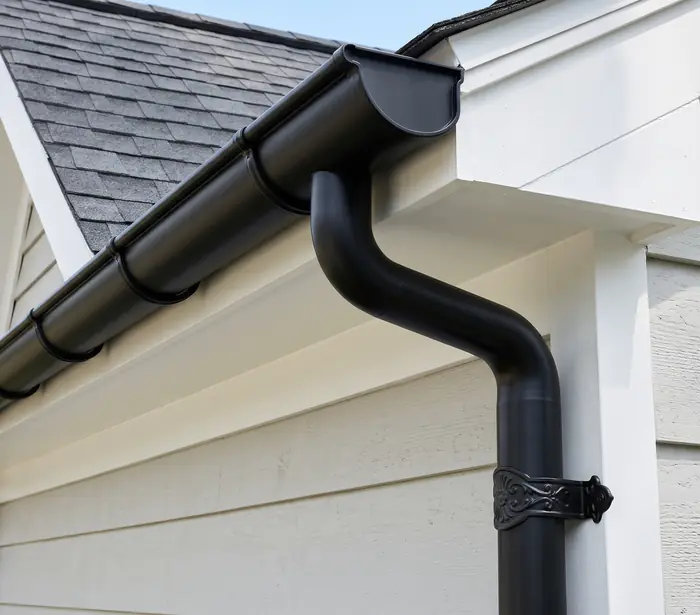
Half-round is the traditional copper profile, with round leaders. K-style copper holds more for its width. Because the semicircle is shallow, half-round often needs to go up a size or gain extra leaders compared with K-style on the same slope. At Arlington's design rate of about 6.84 inches an hour, the This Old House formula gives one half-round length on a 6/12 roof about 330 square feet at 5 inches and 510 at 6 inches. See half-round gutters.
How does the cost stack up?
National guides list copper at $25 to $40 per installed foot, roughly three times seamless aluminum (Angi, This Old House). The economics only work over a long ownership, where the premium is spread across decades.
What maintenance does copper need?
Cleaning, like any gutter; a periodic look at soldered laps; tight brackets. Skip harsh chemicals and abrasive pads, which damage both metal and patina.
Does copper pay back at sale?
Buyers who value it will notice, but it rarely recovers its full cost. Choose it for the house and for your own years there.
Can copper meet aluminum?
Only with a barrier between them. Where a copper front meets aluminum sides, detail the junction so the metals never touch, and keep copper runoff off aluminum below.
What about copper leaders?
Match them: round with half-round, rectangular with K-style, copper or brass straps throughout. Leaders take knocks near the ground, so heavier stock low down is worth considering.
Can old copper be saved?
Often. Laps can be cleaned and resoldered, small holes patched and loose brackets replaced. On a historic house, repairing original copper is worth assessing before replacing it.
Does copper suit Arlington's trees?
The open half-round profile sheds leaves well, and copper shrugs off the tannins in wet leaf litter. It still needs clearing after the autumn drop, and acidic runoff from a copper roof edge can mark mulch beds and stone steps below, so plan where each leader empties.
Is copper a sensible choice for one bay or porch?
Often it is the best use of the budget: a copper bay roof, a front porch or an entry canopy gives the look where it is seen most, while the long rear slopes stay in aluminum. Keep the metals separated where they meet, and size each section for the roof above it.
Who should install it?
Fewer crews solder copper than hang aluminum, so ask for examples of finished copper work. Check that the Virginia license class covers the contract value, since copper projects are often larger than aluminum ones.
Checking a contractor in Virginia
Virginia's Board for Contractors requires a license for any project worth more than $1,000; under the state's consumer statement, a Class C license covers jobs over $1,000 and under $30,000, with Class B and Class A above that. Most gutter jobs cross the $1,000 line, so it is worth looking the business up on the DPOR site before you sign.
- Match the name and license number on the estimate to the DPOR record, and check the license class covers the price of your job.
- Ask to see liability insurance in the business's name, with current dates.
- Insist on a written scope covering gutter size and coil gauge, which hangers and how far apart, every leader and where its water lands, and how the old gutters are disposed of.
- Anyone digging for a buried downspout line must contact Virginia 811 at least three working days ahead. Ask who is placing the request.
To have copper gutters priced, call (571) 470-6545.