
On this page
- How is a new gutter system put in?
- How big should an Arlington gutter be?
- Why does the July 2019 storm matter for sizing?
- Which gutter metals can you choose?
- Do older Arlington houses need anything different?
- Where do the leaders come in?
- What belongs in a written quote?
- How much does installation cost?
- Is it better to wait for a re-roof?
- How can you get ready for the crew?
- What should you inspect once the job is done?
How is a new gutter system put in?
A careful crew works through the same steps on every house:
- Measure each eave and note the roof plane draining to it, including dormers and any upper roof that dumps onto a lower one.
- Inspect the fascia and soffit. Soft, split or stained boards are replaced before anything is hung.
- Choose a size for each run. Front and back rarely need the same gutter.
- Plan the outlets so no downspout is overloaded and none ends beside the basement wall or on a walk.
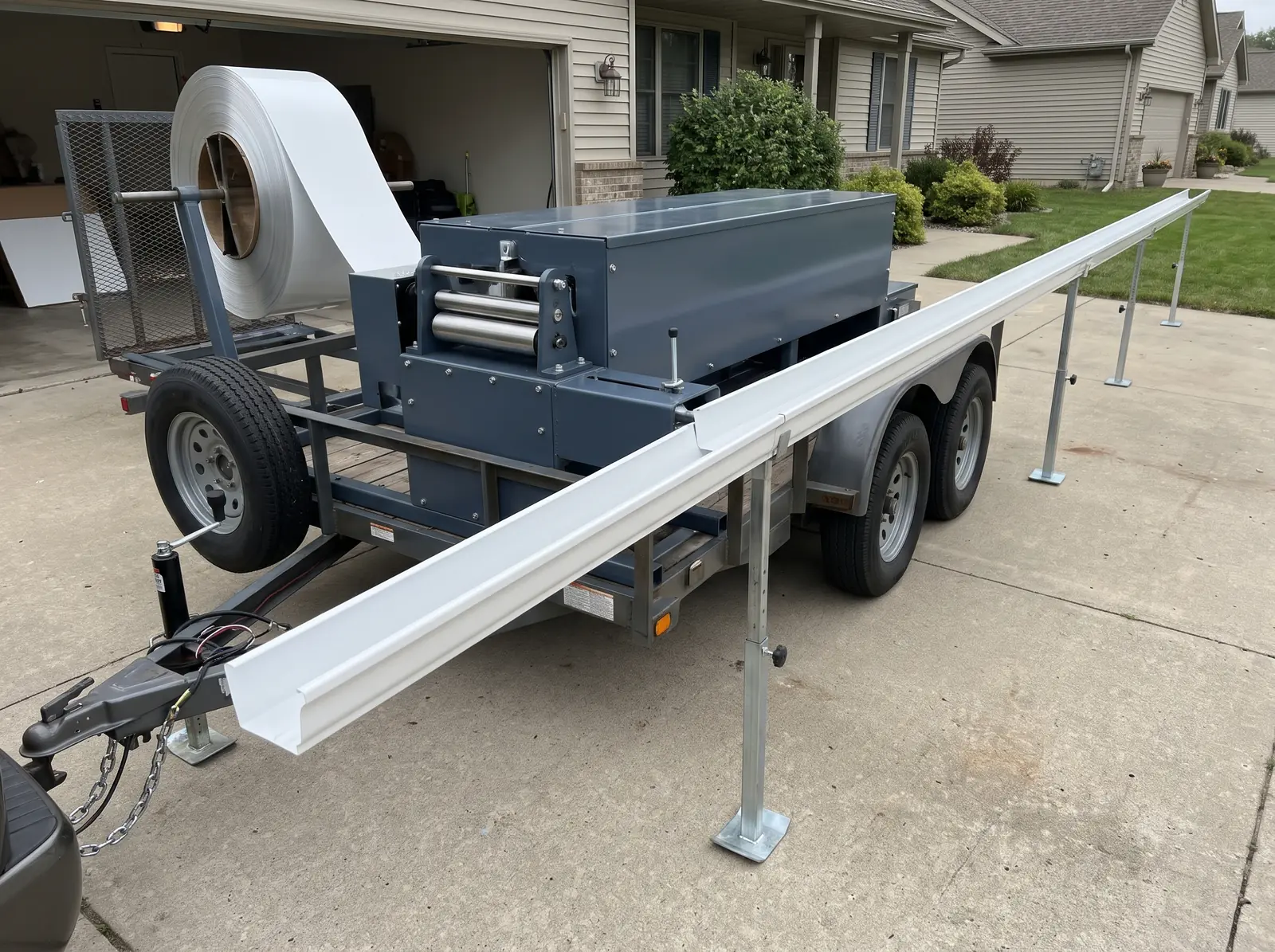
- Roll each length at the curb from coil, cut to the eave, so joins only occur at miters and end caps.
- Set the fall, roughly a quarter inch every ten feet toward each outlet.
- Hang it on hidden hangers screwed into solid wood.
- Seal corners and end caps, fit downspouts and extensions, and run water through every gutter before leaving.
How big should an Arlington gutter be?
The sizing is driven by the most intense few minutes of a storm. For Arlington, NOAA's Atlas 14 gives about 6.84 inches an hour for a 10-year, five-minute burst. Run through the This Old House formula for a 6/12 roof, that works out at roughly:
| Gutter | Roof area per run |
|---|---|
| 5-inch K-style | about 735 sq ft |
| 6-inch K-style | about 1,060 sq ft |
| 5-inch half-round | about 330 sq ft |
| 6-inch half-round | about 510 sq ft |
Measure the plane flat: eave length times the level depth to the ridge. Many front slopes fit within the 5-inch figure. Big rear slopes on two-storey houses, valleys that pour into one corner and steep roofs are the usual candidates for 6-inch. See 5-inch vs 6-inch gutters.
Why does the July 2019 storm matter for sizing?
Because it showed what the upper end looks like. Reagan National logged 3.3 inches between 9 and 10 a.m. on July 8, 2019. No residential gutter carries that cleanly, and none is designed to. The goal is a system that copes with the ordinary hard storms of most summers and fails gently in the extreme ones: spilling over the front rather than backing up behind the fascia, and sending as much water as possible well away from the house. See flash floods and gutters.
Which gutter metals can you choose?
| Material | Strengths | Watch for |
|---|---|---|
| Seamless aluminum | Rust-free, light, wide color range, fair price | Specify .032-inch coil |
| Seamless steel | Stiff and dent-resistant | Coating must stay intact |
| Copper | Very long life, suits historic houses | Price; runoff can stain light masonry |
| Half-round | Traditional look on older homes | Holds less than K-style of the same width |
The typical Arlington job is seamless aluminum in a K-style profile. Copper and half-round show up mostly on early houses in the historic neighborhoods and on upscale remodels.
Do older Arlington houses need anything different?
A large share of Arlington's single-family streets sit in National Register historic districts, from Maywood to Aurora Highlands. On these houses, trim and rafter tails are often original, and the gutter profile is part of the look. Expect the contractor to probe the wood carefully and to discuss half-round or a smaller K-style where a big modern gutter would look heavy. See gutters on historic Arlington homes.
Where do the leaders come in?
They are half the system. A 2x3-inch leader is fine for short sections; a 3x4-inch moves around double the water and jams far less often on seeds and leaf shreds. Where the water lands counts just as much: four feet or more out, onto ground falling away, and never onto the next lot. Arlington County's Stormwater at Home pages suggest directing roof water to a lawn, garden, rain barrel, rain garden or dry well. See downspouts.
What belongs in a written quote?
- Profile, size and metal thickness for each run.
- Hanger type and spacing.
- How many downspouts, what size, and where each discharges.
- Fascia or soffit repairs, priced separately.
- Guards, if any, by type.
- Removal and disposal of the old gutters.
- Any buried line, its outlet, and who places the Virginia 811 request.
- The contractor's labor cover and the manufacturer's terms on coil and finish.
- The contractor's Virginia license number.
How much does installation cost?
Angi and This Old House give national installed ranges per foot: 5-inch seamless aluminum near $9 to $13, 6-inch near $12 to $18, steel $6 to $14 and copper $25 to $40. More detail in what gutters cost in Arlington.
Is it better to wait for a re-roof?
If a re-roof is a year or two away, generally yes. The roofer renews the drip edge, the trim is open for repair, and the new gutters avoid a second removal. Agree in advance between roofer and gutter crew who installs the drip edge.
How can you get ready for the crew?
Clear the drive so the roll-forming trailer can get close, move breakables away from the walls, unlock gates, flag sprinkler heads or buried pipes you know of, and pick colors ahead of time. On a townhouse, give the neighbors notice that ladders may sit on shared ground.
What should you inspect once the job is done?
Walk every wall. Each section should look straight with an even slope, miters should be tidily sealed, leaders snug to the wall and extensions aimed well out. If no hose test happened, request one. Check beds and grass for offcuts and screws.
Checking a contractor in Virginia
Virginia's Board for Contractors requires a license for any project worth more than $1,000; under the state's consumer statement, a Class C license covers jobs over $1,000 and under $30,000, with Class B and Class A above that. Most gutter jobs cross the $1,000 line, so it is worth looking the business up on the DPOR site before you sign.
- Match the name and license number on the estimate to the DPOR record, and check the license class covers the price of your job.
- Ask to see liability insurance in the business's name, with current dates.
- Insist on a written scope covering gutter size and coil gauge, which hangers and how far apart, every leader and where its water lands, and how the old gutters are disposed of.
- Anyone digging for a buried downspout line must contact Virginia 811 at least three working days ahead. Ask who is placing the request.
To have a contractor measure your house, call (571) 470-6545.