
On this page
- Why give downspouts so much attention?
- Which size suits which job?
- How do you work out how many?
- Where can the water go?
- How do rain barrels fit in?
- What makes a buried leader work?
- How should a leader be attached?
- Is a new drop the cheapest overflow cure?
- How do you check the layout works?
- What should the estimate list?
- What about the sump pump?
Why give downspouts so much attention?
Because they are the bottleneck and the exit. A gutter that spills near its drop usually has a leader problem rather than a gutter problem, and a basement that gets damp after storms usually has a discharge problem. Fix those two and much of the trouble goes away.
Which size suits which job?
| Leader | Capacity, roughly | Typical home |
|---|---|---|
| 2x3-inch rectangular | One unit | Porches, sheds, short sections |
| 3x4-inch rectangular | About two units | Two-storey rear slopes, 6-inch gutter, heavy canopy |
| 3- or 4-inch round | Depends on diameter | Half-round systems |
| 4x5-inch or larger | Much more | Garden apartments and commercial roofs |
The larger sizes also have roomier elbows, and that matters under trees, because seeds and catkins jam the first bend before anything else.
How do you work out how many?
From the roof down. At Arlington's 10-year, five-minute intensity of about 6.84 inches an hour, This Old House's sizing method caps one 5-inch K-style section at roughly 735 square feet of 6/12 roof. A long eave can stay under that cap if it is pitched both ways to a leader at each end. As a starting rule, plan one drop per 30 to 40 feet, add one near the base of any large valley, then check the areas.
Where can the water go?
| Choice | Reach | Things to watch |
|---|---|---|
| Splash block | 1 to 2 feet | Rarely far enough beside a basement |
| Extension | 4 to 10 feet | Hinged versions flip up for the mower |
| Solid pipe to a pop-up emitter | 10 feet or more | Needs slope the whole way; daylight on your own lot |
| Rain barrel | Holds water for later | Overflow still needs a route away; empty before winter |
| Rain garden or dry well | Soaks in | Site it well clear of the house |
The County's Stormwater at Home pages recommend sending roof runoff to a garden, lawn, rain barrel, rain garden or dry well. More in downspouts and wet basements.
How do rain barrels fit in?
Arlington offers barrels at low cost through workshops run with partner organizations. Its advice: raise the barrel on blocks, divert the leader into it, and drain and disconnect before the first freeze. A barrel fills in minutes during a cloudburst, so give its overflow a path away from the foundation. The County's fee program also lists voluntary credits for qualifying collection and redirection.
What makes a buried leader work?
- Solid-wall pipe. Perforated pipe leaks the water back into the soil next to the house.
- Continuous slope, start to finish, so nothing pools inside.
- An access cleanout close to the downspout.
- A daylight outlet on your own property, aimed away from neighbors.
- A Virginia 811 ticket at least three working days before the trench goes in, whoever is digging.
How should a leader be attached?
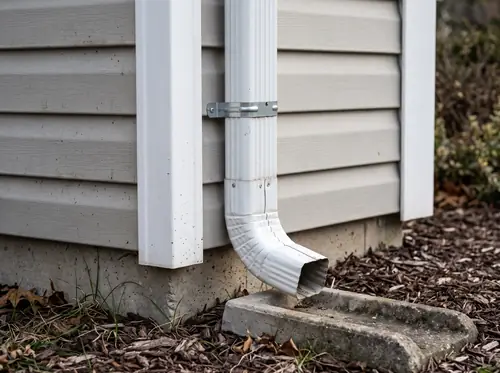
Three straps at least, top, middle and low, fastened into solid backing or, on brick, into masonry anchors. A leader that can wobble twists at the elbow and pulls the drop loose from the gutter. The lowest strap does most of the work on sides of the house where bins and mowers go by.
Is a new drop the cheapest overflow cure?
Very often. Adding a leader halfway along a long section halves the roof each end has to deal with, for a fraction of the cost of new gutter.
How do you check the layout works?
Put a hose in the far end of each gutter and see where water appears. After the next real storm, walk the lot: puddles against the wall, scoured mulch, sheets of water across paving or water heading next door all point to a leader that needs moving or extending.
What should the estimate list?
Leader size and count, location of each, elbows and extensions, any buried line and where it daylights, and who files the Virginia 811 request.
What about the sump pump?
Keep its hose separate from the leaders where practical, and aim it away from the house and the neighbors. A sump that empties beside the foundation just recycles the same water.
Checking a contractor in Virginia
Virginia's Board for Contractors requires a license for any project worth more than $1,000; under the state's consumer statement, a Class C license covers jobs over $1,000 and under $30,000, with Class B and Class A above that. Most gutter jobs cross the $1,000 line, so it is worth looking the business up on the DPOR site before you sign.
- Match the name and license number on the estimate to the DPOR record, and check the license class covers the price of your job.
- Ask to see liability insurance in the business's name, with current dates.
- Insist on a written scope covering gutter size and coil gauge, which hangers and how far apart, every leader and where its water lands, and how the old gutters are disposed of.
- Anyone digging for a buried downspout line must contact Virginia 811 at least three working days ahead. Ask who is placing the request.
To have downspouts planned or added, call (571) 470-6545.