
On this page
- What are the usual faults?
- Why do leaders block?
- How do you clear one safely?
- When is the buried line to blame?
- What does a sound repair include?
- Which upgrades are worth it?
- Where should the water go?
- What about rain barrel diverters?
- Does a leader need a permit to reroute?
- Which jobs suit a homeowner?
- How often should leaders be checked?
- Can colors be matched?
- What does it cost?
What are the usual faults?
| Fault | Tell-tale sign | Normal remedy |
|---|---|---|
| Jammed elbow | Gutter spills near the drop; little water at the foot | Remove the elbow, clear, flush |
| Flattened or kinked piece | Visible damage low down | New piece and elbow |
| Opened seam | Water spraying out halfway down | New piece |
| Straps loose | Leader leans or rattles in wind | Refix into solid backing |
| Drop failing | Drip where the tube meets the gutter | Re-bed or swap the drop |
| Buried line blocked | Water erupting at the joint by the ground | Rod it clear, or relay it |
Why do leaders block?
Almost always at the first bend. Oak catkins, maple seeds, shreds of leaf, shingle grit and the occasional nest wash down and pack into that elbow, and narrow 2x3-inch leaders jam fastest. Under Arlington's mature trees a leader can choke more than once in a season.
How do you clear one safely?
From the ground where possible:
- Clear the drop in the gutter first, or the debris just comes back down.
- Take off the bottom elbow or extension.
- Run a hose down from the top, or work a plumber's snake up from below.
- Put the elbow back and test with water.
Skip the pressure washer; it splits seams and blows debris into the buried line.
When is the buried line to blame?
When water erupts at the connection between leader and buried pipe, the leader itself is probably clear and the blockage is lower down. Years of washed-in debris, pipe laid without enough slope, crushed sections and roots are the usual causes. A cleanout fitting near the house makes future clearing easy. Before any digging, call Virginia 811 at least three working days ahead.
What does a sound repair include?
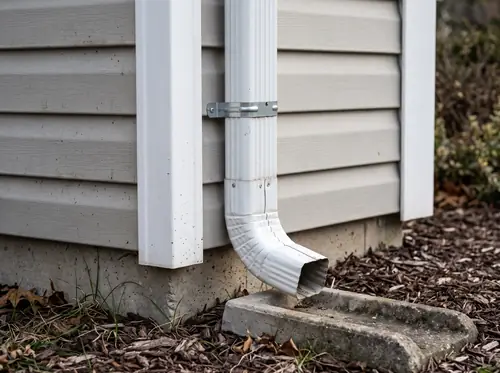
Replacement pieces in the existing profile and color, drops re-bedded, straps high, low and in between fastened into solid backing, a bottom elbow, and an extension that puts the water at least four feet out. On brick, straps go into masonry anchors.
Which upgrades are worth it?
- 3x4-inch leaders where flow is heavy or blockages are common.
- An additional leader on long gutters.
- Hinged or flip-up extensions that survive the mower.
- Strainers at the drop, or a guard fitted to the gutter that feeds it.
- A cleanout on any buried line.
Where should the water go?
Out and away, and on your own property. Arlington's Stormwater at Home pages suggest sending leaders to a garden, lawn, rain barrel, rain garden or dry well. See downspouts and wet basements.
What about rain barrel diverters?
They add joints and a screen that can block. Check them every time the gutters are cleaned. The County recommends draining and disconnecting barrels before the first freeze, so reconnect the leader to its normal extension for winter.
Does a leader need a permit to reroute?
Moving an extension on your own lot is ordinary maintenance. What matters is where the water lands: on your property, away from the foundation and not toward a neighbor. Digging for a buried line still needs a Virginia 811 ticket first.
Which jobs suit a homeowner?
Clearing a bottom elbow, refitting an extension and tightening a low strap are usually fine from the ground or a short stepladder. Replacing pieces high on a two-storey wall, cutting in a new drop or relaying a buried line is crew work.
How often should leaders be checked?
Whenever the gutters are cleaned, after any severe storm, and after the last leaves have dropped in November or December. Running water into each from above beats any visual inspection.
Can colors be matched?
Usually. Leaders are matched either to the gutter or to the wall behind them, and stock colors cover most houses.
What does it cost?
Unclogging an elbow, replacing one piece or fitting an extension sits at the cheap end of gutter work. Digging up and relaying an underground pipe is a different scale of job, priced by length and access.
Checking a contractor in Virginia
Virginia's Board for Contractors requires a license for any project worth more than $1,000; under the state's consumer statement, a Class C license covers jobs over $1,000 and under $30,000, with Class B and Class A above that. Most gutter jobs cross the $1,000 line, so it is worth looking the business up on the DPOR site before you sign.
- Match the name and license number on the estimate to the DPOR record, and check the license class covers the price of your job.
- Ask to see liability insurance in the business's name, with current dates.
- Insist on a written scope covering gutter size and coil gauge, which hangers and how far apart, every leader and where its water lands, and how the old gutters are disposed of.
- Anyone digging for a buried downspout line must contact Virginia 811 at least three working days ahead. Ask who is placing the request.
To have a leader cleared, repaired or upsized, call (571) 470-6545.