
On this page
- What are these boards, exactly?
- What rots them?
- How can you check from the ground?
- How does a repair usually go?
- Which materials are options?
- What about older houses?
- How is trim repair priced?
- How do you stop it recurring?
- What if animals are getting in?
- Is this work for a roofer or a gutter crew?
- How long does trim repair add?
- What is the link to the basement?
What are these boards, exactly?
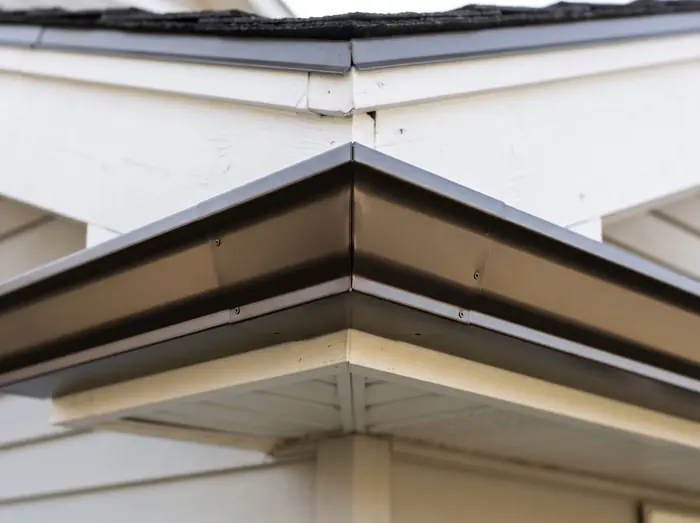
The fascia is the vertical board fixed to the rafter ends along the eave. The gutter hangs on it. Beneath it, the soffit closes off the overhang back to the wall, and it is often vented to feed air into the attic. Both are trim, and both suffer when water is not kept in the gutter.
What rots them?
| Source | How it happens |
|---|---|
| Missing or misplaced drip edge | Roof water curls under the shingles and trickles down the wood |
| Leaking miters | A steady drip in one place |
| Overflow | Storm water pouring over the front lip wets the face of the trim |
| Ice | An occasional cold snap can push water under the roof edge |
| Animals | Openings in soft soffit let in insects, birds and squirrels |
How can you check from the ground?
Look along the eave for flaking paint, dark streaks, a gap opening between gutter and board, and hangers tipping forward. Up a ladder, a screwdriver pushed into the wood tells the story: it should meet firm resistance, not sink in. Check corners and the area behind each drop, where water gathers first.
How does a repair usually go?
- Take the gutter down along the affected stretch.
- Cut out soft wood back to sound material.
- Fit new board, primed on every face, or a rot-proof alternative.
- Repair soffit panels and vents as needed.
- Fix or add drip edge so roof water lands in the gutter.
- Rehang the gutter on new hangers at the right slope.
Which materials are options?
| Material | Strengths | Watch-outs |
|---|---|---|
| Primed wood | Cheapest; easy to match older profiles | Needs painting; rots if water comes back |
| PVC or composite | Rot-proof | Costs more; profile may differ |
| Metal cladding over sound wood | No painting; sheds water | Never over rot; careless cladding traps water |
What about older houses?
On historic houses the trim is part of the look. Matching the profile when replacing board keeps the eave line right, and many owners stay with painted wood for that reason. In a locally designated district, street-facing trim changes may need review. See gutters on historic Arlington homes.
How is trim repair priced?
Usually by the foot, once the gutter is down and the extent of the soft wood is clear. Having a rate per foot written into the gutter quote keeps the final bill predictable if more soft wood turns up.
How do you stop it recurring?
Remove the cause: have the drip edge overlap the gutter's back, re-bed leaking miters, cure overflow, and keep gutters clean so water does not stand against the board.
What if animals are getting in?
Get them out first, calling in a wildlife removal service if needed, and only then renew the chewed panels and seal the openings. Keep soffit vents open; blocking them traps moisture in the attic.
Is this work for a roofer or a gutter crew?
Both do it. Gutter crews often replace short stretches of board as part of a rehang; larger runs of trim, or work that involves the roof edge, may suit a roofer or carpenter. On a re-roof, coordinate both trades so the drip edge goes back in the right order.
How long does trim repair add?
A short stretch of board is often done in the same visit as the rehang. Long runs, curved or decorative trim, or soffit and vent repairs can add a day, and painted wood needs dry weather for primer and paint before the gutter goes back up.
What is the link to the basement?
Indirect but real. Soft board lets gutters dip and spill, and spilled water ends up against the foundation. Sound trim keeps the system level and the water moving to the leaders.
Checking a contractor in Virginia
Virginia's Board for Contractors requires a license for any project worth more than $1,000; under the state's consumer statement, a Class C license covers jobs over $1,000 and under $30,000, with Class B and Class A above that. Most gutter jobs cross the $1,000 line, so it is worth looking the business up on the DPOR site before you sign.
- Match the name and license number on the estimate to the DPOR record, and check the license class covers the price of your job.
- Ask to see liability insurance in the business's name, with current dates.
- Insist on a written scope covering gutter size and coil gauge, which hangers and how far apart, every leader and where its water lands, and how the old gutters are disposed of.
- Anyone digging for a buried downspout line must contact Virginia 811 at least three working days ahead. Ask who is placing the request.
To have trim checked and gutters rehung, call (571) 470-6545.