
On this page
- What makes a guard pay off?
- How do guard styles stack up?
- When is a guard an easy yes?
- When is a guard hard to justify?
- How do guards handle a cloudburst?
- How do you run the numbers?
- What prep comes before a guard?
- How much upkeep remains with guards?
- What about partial coverage?
- Do guards make sense if you may sell soon?
- How do different trees test a guard?
- Can guards cut down mosquitoes?
- What about condo and townhouse roofs?
- Do guards need to go on every section?
- Which sales claims deserve a question?
What makes a guard pay off?
Four things:
- What falls on the roof. Arlington County aims for at least 40 percent tree canopy, and many older streets have mature trees over the houses. More canopy means more cleaning.
- Reach. Two- and three-storey walls and steep pitches make each visit slower and more hazardous.
- Frequency. Two, three or four cleaning visits a year mount up.
- What overflow costs you. Water spilling beside a basement wall has a price that never shows on an invoice.
How do guard styles stack up?
| Type | Under Arlington trees | In a cloudburst | Durability |
|---|---|---|---|
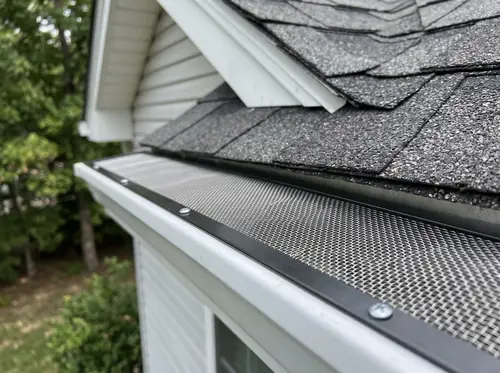
| Micro-mesh | Stops most fine debris | Good if kept clear | Long, if stainless |
| Metal screen | Large leaves only | Good | Good |
| Plastic screen | Large leaves only | Good | Poor; brittle in sun |
| Reverse-curve hood | Large leaves | Can overshoot | Good |
| Foam or brush | Short-term | Poor | Poor |
When is a guard an easy yes?
- Tall houses under large trees.
- Houses needing three or more cleans a year.
- Roofs too high or steep for the owner to reach safely.
- Gutters that clog and overflow between cleans.
When is a guard hard to justify?
- Low houses with little overhanging canopy.
- Gutters that are old, leaking or undersized: fix those first.
- Roofs where the main debris is fine grit that passes any guard.
How do guards handle a cloudburst?
Arlington's 10-year, five-minute rain rate is about 6.84 inches an hour. Clean micro-mesh passes that on a properly sized gutter. Mesh coated with fine debris may shed some over the front, and hood covers can overshoot on steep roofs. In an extreme storm like July 2019, gutters spill with or without guards.
How do you run the numbers?
- Count the cleans a year you need now.
- Multiply by the price of each clean.
- Add anything overflow is costing: fascia repairs, stained siding, damp basement walls.
- Set that against the installed price of a decent micro-mesh guard for your total length.
- Divide to see roughly how many years until they break even.
A worked example: call the cost of one clean C. At three a year, five years of cleaning is 15C. With guards fitted you might still book one service visit yearly, so five years costs the guard price G plus 5C. The guards come out ahead over five years whenever G is below 10C.
What prep comes before a guard?
Clean, reseal joints, rehang dips, upsize outlets if needed and replace soft fascia. Guards belong on a gutter that already works.
How much upkeep remains with guards?
Brushing the mesh once or twice a year, more after spring pollen and catkins; checking after storms; flushing downspouts. See tree debris and gutter cleaning.
What about partial coverage?
Many owners fit guards only on the runs under trees and leave open runs bare. That cuts the cost while protecting the gutters that clog most.
Do guards make sense if you may sell soon?
It hinges on how long you plan to stay. Buyers seldom pay extra for guards; tidy gutters and sound drainage count for more with them and their inspectors. If you expect five or more years under heavy canopy, guards are easier to justify.
How do different trees test a guard?
Each kind of debris tests a guard differently. Catkins and pollen in spring form a fine mat that slows water through mesh. Winged seeds lodge in screens and sprout in damp debris. Broad autumn leaves sit on top of any guard and usually blow off once dry. Pine needles slip through coarse screens and lie flat on mesh. Twigs and small branches, common after summer storms, can bridge a hood's slot. Fine stainless mesh copes with the widest mix, which is why it is the usual recommendation under mixed canopy.
Can guards cut down mosquitoes?
Indirectly. A gutter full of wet leaves holds water, and standing water breeds mosquitoes in summer. A guard keeps the leaves out, but the gutter still needs a steady fall to drain. If water sits under a guard after rain, the run needs rehanging.
What about condo and townhouse roofs?
On shared roofs, guards work best when a whole building is done at once, so a clogged run next door does not back water into yours. Associations often price guards building by building and fund them from reserves alongside cleaning contracts.
Do guards need to go on every section?
No. Put guards on the sections beneath the trees and leave exposed sections open, clearing those yearly. That trims the cost, and the rear slope under the largest trees is usually where guards repay themselves soonest.
Which sales claims deserve a question?
| Claim | What to ask |
|---|---|
| "Never clean your gutters again" | What maintenance does the maker recommend? |
| "Handles any rainfall" | Tested at what rate, on what pitch? |
| "Lifetime warranty" | Covering what, and does it transfer? |
| "Today-only price" | Can I have the written quote to compare? |
| "Licensed and approved" | What is the Virginia license number? |
To have guards priced against the cost of cleaning, call (571) 470-6545.