
On this page
- How is it built?
- Why does it suit Arlington?
- What happens in a downpour?
- What maintenance remains?
- Who is it wrong for?
- Does it work on shallow roofs?
- What should the quote spell out?
- Is the brand what matters?
- Will it change roof replacement?
- Does it pay for itself?
- How long does micro-mesh last?
- Can micro-mesh go on old gutters?
- Does it help with mosquitoes?
How is it built?
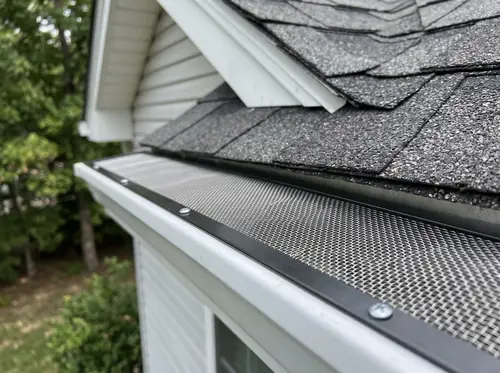
A stiff aluminum frame bridges the gutter, holding stainless mesh whose holes are far smaller than a seed. Water is drawn through by surface tension; debris sits on the surface until a breeze or the next shower clears it. Better products screw to the front lip and fix at the back to the drip edge or under the first shingle course.
Why does it suit Arlington?
Because what falls on local roofs is a mixture of big and tiny. Broad leaves come down in autumn, but a lot of what actually jams gutters is small: catkins and pollen in spring, seeds and shredded leaves in summer storms. The County aims for a canopy of at least 40 percent, and on older streets big trees hang over many roofs. Coarse screens let the small material through. Fine mesh keeps almost all of it out.
What happens in a downpour?
Arlington's 10-year, five-minute intensity is about 6.84 inches an hour. Clean mesh on a correctly sized gutter keeps up well. Once pollen, grit and leaf dust coat it, flow slows, and in the most intense bursts some water skims off the front. An occasional brush restores it.
What maintenance remains?
| Job | Timing |
|---|---|
| Brush the mesh surface | Twice yearly as a rule, plus after a heavy pollen or seed season |
| Look inside at a few spots | Every year or two |
| Flush leaders | Yearly |
| Check fastenings | After big storms |
Who is it wrong for?
Owners of a single-storey house in open ground, where a yearly clean is quick and cheap. Owners with leaking or dipping gutters, who should fix those first. And anyone whose roofing warranty forbids disturbing shingles, unless they choose a product that fixes only to drip edge and lip.
Does it work on shallow roofs?
Where the roof is fairly flat, litter tends to settle and stay, which makes the brushing more important. On steep roofs some water may overshoot in a cloudburst; frame profile and fixing angle make a difference.
What should the quote spell out?
| Item | Look for |
|---|---|
| Mesh | Stainless |
| Frame | Rigid, screwed to the lip |
| Rear fixing | Drip edge or under shingles; whether shingles are disturbed |
| Preparation | Cleaning, re-bedding and rehanging listed |
| Corners | How miters are closed |
| Price | Rate per foot, plus the total length |
| Cover | Written terms from both maker and installer |
Is the brand what matters?
Less than the details: mesh fineness, frame rigidity, the fixings, and the corner detail, because inside and outside miters are where budget products tend to leave openings.
Will it change roof replacement?
Roofers will need the guards removed during a re-roof. Ask whether they come off and go back on without damage, and whether either trade charges for it.
Does it pay for itself?
On a two- or three-storey house under mature trees, it often does. On a single-storey house with few trees nearby, a yearly clean is usually the better buy. See are gutter guards worth it?.
How long does micro-mesh last?
Stainless mesh in a rigid aluminum frame is built to outlast several cleaning cycles; the fixings and the gutter underneath usually set the real lifespan. Ask what the maker's written terms cover, and whether the installer's workmanship terms are separate, before comparing prices from different crews side by side.
Can micro-mesh go on old gutters?
Only if they are worth keeping. Fitting mesh to gutters that leak at the miters, dip between hangers or are too small for the slope above locks in those problems and makes them harder to reach. Most crews clean, re-bed and rehang first, and price that work separately.
Does it help with mosquitoes?
It can play a part. A gutter that empties fully holds no standing water. Mesh keeps debris from damming the channel, but a dip that holds water must still be rehung.
Checking a contractor in Virginia
Virginia's Board for Contractors requires a license for any project worth more than $1,000; under the state's consumer statement, a Class C license covers jobs over $1,000 and under $30,000, with Class B and Class A above that. Most gutter jobs cross the $1,000 line, so it is worth looking the business up on the DPOR site before you sign.
- Match the name and license number on the estimate to the DPOR record, and check the license class covers the price of your job.
- Ask to see liability insurance in the business's name, with current dates.
- Insist on a written scope covering gutter size and coil gauge, which hangers and how far apart, every leader and where its water lands, and how the old gutters are disposed of.
- Anyone digging for a buried downspout line must contact Virginia 811 at least three working days ahead. Ask who is placing the request.
To have micro-mesh guards measured and priced, call (571) 470-6545.