
On this page
- How do you tell if 5-inch is outmatched?
- Which local houses are typical candidates?
- Why change the leaders as well?
- Does 6-inch stop all overflow?
- What are the downsides?
- How do you confirm the existing gutters are too small?
- What should the quote spell out?
- Can you double-check the sizing?
- How does roof pitch affect it?
- Does 6-inch need a taller eave board?
- What about garages and porches?
- How do you handle a historic street front?
How do you tell if 5-inch is outmatched?
Compare roof area with capacity. NOAA's Atlas 14 gives Arlington about 6.84 inches an hour for a 10-year, five-minute storm. Using This Old House's sizing approach at 6/12:
| K-style size | Roof per length |
|---|---|
| 5-inch | about 735 sq ft |
| 6-inch | about 1,060 sq ft |
Picture a rear slope 48 feet long and 17 feet deep: 816 square feet in plan, already past 5-inch. Put a dormer or upper roof above it, or a valley emptying into its corner, and 6-inch is plainly the right call.
Which local houses are typical candidates?
- Two-storey houses with long uninterrupted rear slopes.
- Older homes with big rear additions draining into the original gutter.
- Steep roofs, which deliver water faster and catch wind-blown rain.
- Roofs where a valley empties at one point.
- Lots under heavy canopy, where the bigger channel buys time between cleans.
Why change the leaders as well?
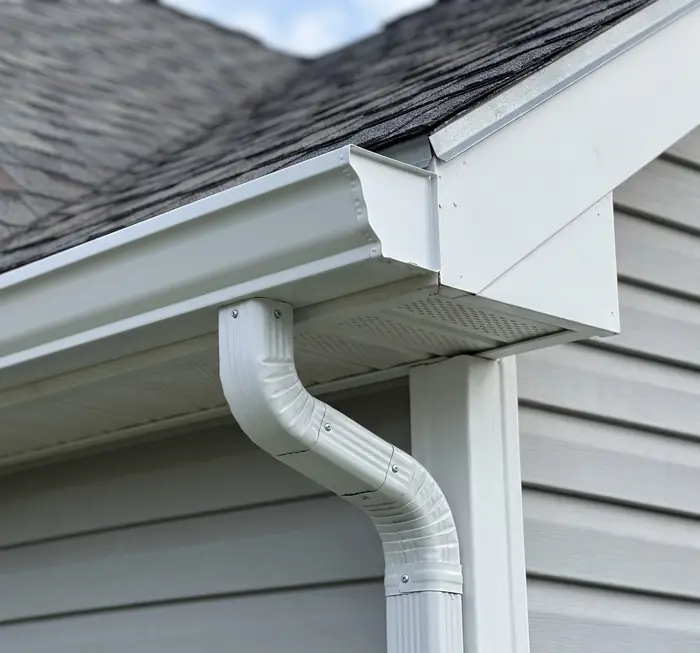
The leader is often what limits flow first. A 3x4-inch leader carries roughly double a 2x3 and is less prone to blockage. With 6-inch gutter, 3x4 is standard; place one close to the foot of each valley. See downspouts.
Does 6-inch stop all overflow?
No. On July 8, 2019, Reagan National logged 3.3 inches in an hour, beyond what any house gutter carries. A 6-inch system handles the ordinary hard storms of most summers and sends more water further from the foundation when the big one comes. See flash floods and gutters.
What are the downsides?
- Price: the national ranges run near $12 to $18 per installed foot for 6-inch, compared with $9 to $13 for 5-inch (Angi, This Old House).
- Load: a full 6-inch channel is heavier, so the eave board and hangers must be sound.
- Appearance: heavier-looking on small houses and fine historic facades.
- Guards: confirm your preferred guard comes in 6-inch.
- Board depth: the eave board must be tall enough for the larger back.
How do you confirm the existing gutters are too small?
Clean them, then watch during a hard summer storm. Water pouring over along the full length says the length is too small or short of leaders. Water spilling only at one inside corner usually means a valley, which a diverter or an extra leader can handle without upsizing. See 5-inch vs 6-inch gutters.
What should the quote spell out?
The size chosen for each length, metal gauge, leader size and count, hanger type and spacing, and where each leader discharges. A one-size-everywhere quote without measurements is a guess.
Can you double-check the sizing?
Ask for the plan area measured for each slope. A contractor who measured should be able to tell you, say, that the back slope is about 900 square feet and so gets 6-inch, while a 200-square-foot porch stays 5-inch. Compare against the table above.
How does roof pitch affect it?
Steeper slopes push water off faster, so the sizing method reduces the area each gutter can serve as pitch increases. A 10/12 roof that would just fit 5-inch at 6/12 may tip into 6-inch territory.
Does 6-inch need a taller eave board?
Its back is higher than a 5-inch gutter's, so the board has to be deep enough to take it below the drip edge. On houses with shallow boards, a contractor may add a strip or choose a different hanger.
What about garages and porches?
Small roofs rarely need 6-inch; 5-inch with a single leader is plenty. Spend the money where the slopes are big.
How do you handle a historic street front?
A wide modern gutter can look clumsy on a delicate older facade. Many owners put 6-inch on the back, where the large slope is, and a smaller K-style or half-round on the front. See gutters on historic Arlington homes.
Checking a contractor in Virginia
Virginia's Board for Contractors requires a license for any project worth more than $1,000; under the state's consumer statement, a Class C license covers jobs over $1,000 and under $30,000, with Class B and Class A above that. Most gutter jobs cross the $1,000 line, so it is worth looking the business up on the DPOR site before you sign.
- Match the name and license number on the estimate to the DPOR record, and check the license class covers the price of your job.
- Ask to see liability insurance in the business's name, with current dates.
- Insist on a written scope covering gutter size and coil gauge, which hangers and how far apart, every leader and where its water lands, and how the old gutters are disposed of.
- Anyone digging for a buried downspout line must contact Virginia 811 at least three working days ahead. Ask who is placing the request.
To have each slope measured and sized, call (571) 470-6545.