
On this page
- Why is aluminum the default here?
- Which gauge makes sense?
- What does Arlington heat do to aluminum?
- How should it be fixed?
- Which size?
- How does it compare with steel and copper?
- Which color?
- What gives out first?
- Can it sit next to copper?
- Does it suit older houses?
- What about the leaders?
- How does aluminum cope under Arlington's canopy?
- Is painting worthwhile?
- Does old aluminum get recycled?
Why is aluminum the default here?
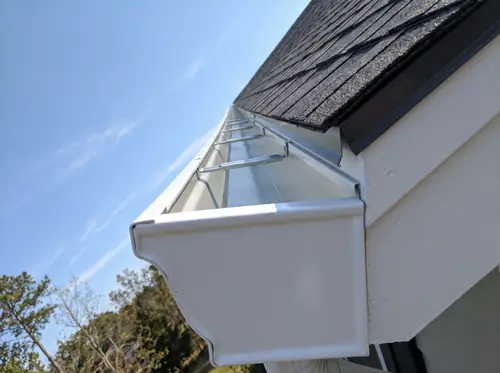
It hits the best compromise. No rust to manage, light enough to spare old trim, an easy color match to almost any house, and every crew can roll a replacement length in the driveway. Steel and copper each win on one point; aluminum wins on the whole package for most homes.
Which gauge makes sense?
| Gauge | Character | Sensible use |
|---|---|---|
| .027-inch | Thinner; kinks under ladders and falling twigs | Short, sheltered lengths on a tight budget |
| .032-inch | Stiffer; keeps its line | Standard choice for houses |
| .040-inch | Heavier again | Large profiles and commercial roofs |
On streets with mature trees, a branch landing on the eave is a bigger risk than the weather. The small premium for .032 pays off the first time that happens.
What does Arlington heat do to aluminum?
Aluminum's expansion is high. From a winter night to a July afternoon (Reagan National's record is 106°F), a long length changes noticeably in size. Short and medium lengths absorb that. Long ones need a slip joint or should be split to drain both ways, or the caulk at the ends works loose and hangers strain.
How should it be fixed?
Concealed hangers screwed into sound eave board or rafter ends, at a spacing that carries a channel full of wet leaves. Spike-and-ferrule fixing is out of date; it loosens as the wood moves. Ask about spacing under valleys and along long lengths.
Which size?
Using Arlington's 10-year, five-minute rate of about 6.84 inches an hour and This Old House's method, one 5-inch K-style length on a 6/12 roof serves roughly 735 square feet and a 6-inch length roughly 1,060. See 6-inch gutters.
How does it compare with steel and copper?
By national figures from Angi and This Old House, installed seamless aluminum runs about $9 to $18 a foot depending on size, steel $6 to $14 and copper $25 to $40. Steel is the stiffer metal but its coating needs care; copper outlives both and suits historic houses, at several times the cost. See aluminum vs steel vs copper gutters.
Which color?
Factory finishes come in dozens of shades. Match trim rather than walls, and choose leaders to blend into whatever is behind them. Dark colors hide streaks; finishes on sunny south and west elevations may fade a little faster.
What gives out first?
Rarely the aluminum itself. Caulk at miters and end caps ages, hangers loosen in tired wood, and the finish slowly dulls. Re-bedding miters now and then and swapping loose hangers keeps a system working for decades.
Can it sit next to copper?
Not touching. Where a copper bay or valley drains into aluminum, the two react. Use a barrier or a different detail, and keep copper runoff off aluminum below.
Does it suit older houses?
Usually, in a modest size and trim-matched color. Aluminum half-round exists for houses where the rounded look suits. See gutters on historic Arlington homes.
What about the leaders?
Match them to the gutter. 3x4-inch suits most two-storey lengths and clogs less than 2x3. A low strap keeps leaders straight where bins and mowers pass.
How does aluminum cope under Arlington's canopy?
Well, as long as the coil is heavy enough. Oak and maple litter, seed pods and twigs collect in any gutter; the risk for aluminum is a dropped limb or a ladder leaned on the lip, which kinks thin coil. Heavier gauge, close hanger spacing and a stand-off for ladders keep it straight through years of summer storms.
Is painting worthwhile?
On new work, no; factory finish outlasts site paint. Painting is mostly a way to refresh a faded but sound older system.
Does old aluminum get recycled?
Yes. Ask whether the removal price assumes the crew keeps the scrap.
Checking a contractor in Virginia
Virginia's Board for Contractors requires a license for any project worth more than $1,000; under the state's consumer statement, a Class C license covers jobs over $1,000 and under $30,000, with Class B and Class A above that. Most gutter jobs cross the $1,000 line, so it is worth looking the business up on the DPOR site before you sign.
- Match the name and license number on the estimate to the DPOR record, and check the license class covers the price of your job.
- Ask to see liability insurance in the business's name, with current dates.
- Insist on a written scope covering gutter size and coil gauge, which hangers and how far apart, every leader and where its water lands, and how the old gutters are disposed of.
- Anyone digging for a buried downspout line must contact Virginia 811 at least three working days ahead. Ask who is placing the request.
To have aluminum gutters measured and priced, call (571) 470-6545.