
On this page
- Which joins give trouble?
- What makes joins fail here?
- How do you track a leak down?
- What does a lasting reseal look like?
- Why won't caulk stop water behind the gutter?
- What happens if a leak is left?
- When should you stop resealing?
- Can you do it yourself?
- What about copper?
- Where do drops leak?
- Will a leak show up on a home inspection?
- Do leaks get worse in a cloudburst?
- When should leaks be fixed?
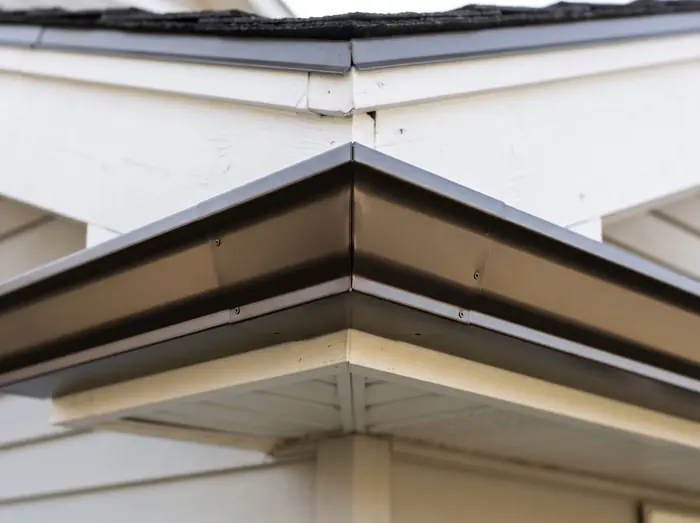
Which joins give trouble?
| Join | Typical failure | Remedy |
|---|---|---|
| Miters | Caulk splits as lengths move | Strip, clean and re-bed, or fit a new miter |
| End caps | Caulk shrinks away | Remove, clean, re-bed and rivet |
| Drops | Sealant around the tube lets go, or the floor cracks | Re-bed or replace the drop |
| Sectional laps | Every ten feet, each a weak point | Re-bed, or move to seamless |
| Back edge | Water slips between gutter and board | Correct or add drip edge |
| Pinholes | Corrosion or impact | Patch small ones; replace the length if larger |
What makes joins fail here?
Movement, mostly. Aluminum grows and shrinks more than most building materials, and the swing between a January night and a 100-degree July afternoon (Reagan National's record is 106°F) is large. Miters and end caps take that strain every day. Wet debris pressed against a join, and the occasional hard freeze, speed things along.
How do you track a leak down?
Wait for a dry day, run a garden hose into the high end, and watch from below. A drip at a miter or end cap means the caulk. A sheet of water down the face of the eave board means the gutter's back edge. A drip from the middle of a seamless length means a hole. Old stains, blistered paint and spongy wood under the gutter mark where water has been going for months.
What does a lasting reseal look like?
- Dry the join and dig out every bit of old caulk.
- Clean the metal until it is bright.
- Swap any loose rivets or screws.
- Bed gutter sealant inside the join rather than smearing it over the outside.
- Let it cure, then hose-test.
Done properly on a dry day, it holds for years.
Why won't caulk stop water behind the gutter?
Because the problem is geometry. Roof water should leave the shingles, cross the drip edge and drop into the channel. If the gutter was hung above the drip edge, or there is no drip edge, water clings to the underside and runs down the board. Fit or reposition the drip edge, or lower the gutter.
What happens if a leak is left?
- The eave board rots and stops holding hangers. See fascia and soffit.
- Siding and brick stain under the drip.
- Paint peels on older trim.
- The soil at that corner stays wet, close to the basement wall.
When should you stop resealing?
When old sectional gutter weeps at lap after lap, when the same miters reopen within a season, or when the system is also dipping or too small. Repair or replace gutters has a scorecard.
Can you do it yourself?
A single-storey miter in dry weather, with a steady ladder and a helper, is within reach for many owners. The cleaning is the part people skip, and it is the part that matters. Leave anything higher to a crew.
What about copper?
Copper joins are soldered. A weeping copper lap gets cleaned and resoldered by someone who works with copper; caulk is the wrong answer.
Where do drops leak?
Where the tube is sealed into the gutter floor, and around the hole if impact or corrosion has cracked it. Loose drops are re-bedded; cracked ones are cut out and replaced. Check the first elbow too, since a blockage there backs water up into the join.
Will a leak show up on a home inspection?
Usually. Inspectors look for stained boards, blistered paint under gutters and dripping miters. A repaired join and sound trim are easier to explain than an active leak.
Do leaks get worse in a cloudburst?
Yes. A join that only weeps in a shower can pour in a heavy storm, when the gutter runs full and water stands against every lap.
When should leaks be fixed?
Any dry, mild spell works; late summer and early autumn are ideal, leaving the system tight before leaf fall and winter storms.
Checking a contractor in Virginia
Virginia's Board for Contractors requires a license for any project worth more than $1,000; under the state's consumer statement, a Class C license covers jobs over $1,000 and under $30,000, with Class B and Class A above that. Most gutter jobs cross the $1,000 line, so it is worth looking the business up on the DPOR site before you sign.
- Match the name and license number on the estimate to the DPOR record, and check the license class covers the price of your job.
- Ask to see liability insurance in the business's name, with current dates.
- Insist on a written scope covering gutter size and coil gauge, which hangers and how far apart, every leader and where its water lands, and how the old gutters are disposed of.
- Anyone digging for a buried downspout line must contact Virginia 811 at least three working days ahead. Ask who is placing the request.
To have a leak found and fixed, call (571) 470-6545.