
On this page
- What pulls gutters down?
- How can you catch it early?
- What does rehanging involve?
- When is a dip the tip of something bigger?
- Why does it matter in summer?
- What about older houses?
- Is it a DIY job?
- How close should hangers be?
- Can a dip harm the roof?
- What if the gutter is already on the ground?
- Does a townhouse row need special care?
- How do you keep it from happening again?
What pulls gutters down?
| Culprit | How it works | Remedy |
|---|---|---|
| Spikes and ferrules | Back out as the wood swells and dries | Swap for screwed concealed hangers |
| Rotten board | Nothing for screws to grip | New board, then rehang |
| Wet leaves | Add weight and hold water | Clean; consider guards |
| Standing water | Each storm adds more weight to the dip | Reset the slope |
| Falling limbs | Bend the section | Replace damaged lengths |
| Ladders | Leaned on the lip, they kink it | Use a stand-off |
| Occasional ice | Extra weight in a cold snap | Closer, stronger hangers |
How can you catch it early?
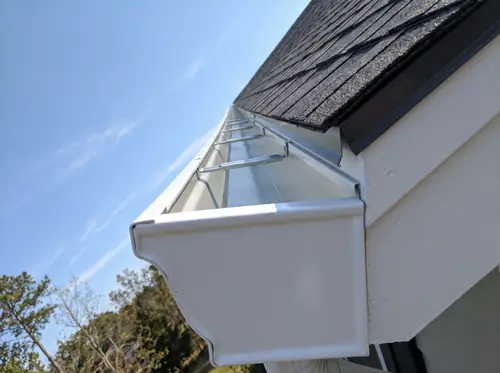
Sight along the gutter from one end; the line should drop gently toward the leader. Warning signs are a lip tilting outward, daylight between gutter and board, water still sitting a day after rain, and spike heads standing proud of the metal.
What does rehanging involve?
- Clear the section and take out or test the old fixings.
- Probe the board; cut out anything soft and fit new wood.
- Screw concealed hangers into sound board or rafter ends, set close together.
- Re-establish a gentle slope, roughly a quarter inch every ten feet toward the leader.
- Re-bed any joins disturbed along the way.
- Hose-test to make sure nothing pools.
When is a dip the tip of something bigger?
When soft wood runs along most of a side, when rafter ends have rotted, or when the gutter is simply too small and overflowing constantly. Then the job becomes trim repair or a new system. See fascia and soffit and repair or replace gutters.
Why does it matter in summer?
Warm, still water breeds mosquitoes, and every storm adds weight right where the fixings are already weakest. In a cloudburst, the low point also becomes the place where water pours over the lip, straight onto the ground beside the foundation.
What about older houses?
Dips on historic houses often reveal soft board or rafter ends hidden under decades of paint. Good practice is to probe first, repair in a matching profile, and only then rehang. See gutters on historic Arlington homes.
Is it a DIY job?
Replacing a couple of loose hangers in sound wood on a single-storey house is manageable. A whole section, any board replacement, or anything higher needs a crew, since the gutter has to come down and go back up at the right slope.
How close should hangers be?
Two feet apart is a common starting point for concealed hangers in K-style aluminum, closer under valleys, along long sections and under heavy trees. Half-round brackets usually go closer still. Ask what spacing the contractor proposes.
Can a dip harm the roof?
Yes. A gutter leaning forward can bend the drip edge and lift the bottom row of shingles, letting water into the roof edge. If the lean has been there a while, have that edge checked too.
What if the gutter is already on the ground?
Keep people away, move it off paths if that is safe, and take photos where it fell, particularly after a storm. Many fallen sections can go back up if the metal is straight; bent ones are replaced. Look at the board where it tore away, since the old screw holes often show soft wood behind the paint.
Does a townhouse row need special care?
Yes. On attached houses one continuous gutter often spans several owners, so a dip at one unit can send water along to the next. Coordinate with neighbors or the association before rehanging, and keep the slope continuous across the joins so water reaches the right leader.
How do you keep it from happening again?
- Concealed hangers screwed into solid wood at close spacing.
- .032-inch coil, which holds its line better than .027.
- Clean gutters, especially through the autumn leaf drop.
- Ladders kept off the lip.
- Overhanging limbs trimmed back by a certified arborist before the summer storm season.
Checking a contractor in Virginia
Virginia's Board for Contractors requires a license for any project worth more than $1,000; under the state's consumer statement, a Class C license covers jobs over $1,000 and under $30,000, with Class B and Class A above that. Most gutter jobs cross the $1,000 line, so it is worth looking the business up on the DPOR site before you sign.
- Match the name and license number on the estimate to the DPOR record, and check the license class covers the price of your job.
- Ask to see liability insurance in the business's name, with current dates.
- Insist on a written scope covering gutter size and coil gauge, which hangers and how far apart, every leader and where its water lands, and how the old gutters are disposed of.
- Anyone digging for a buried downspout line must contact Virginia 811 at least three working days ahead. Ask who is placing the request.
To have a dipping section rehung, call (571) 470-6545.